
Klarbot | Agentic German Simplification with a Reference-Free Score
An agent that rewrites German into Einfache Sprache, steered by KLAR, a reference-free simplicity metric validated across four German corpora.Aug 13, 2026
Klarbot is the agentic system I built at Fraunhofer IAIS to rewrite dense German administrative text into Einfache Sprache, plainer German for readers who struggle with officialese. A Translator drafts, a Supervisor decides whether to accept the draft, and a question-answer pair checks that the rewrite still carries the facts of the original. The engineering story is in the blogpost Engineering Agents That Know When to Stop.
Since that post, we published “Alles KLAR? A Rule-Based Simplicity Score for German Text Simplification” (with Johannes Leveling), accepted at KlarText 2026 @ KONVENS. The paper introduced two main additions.
1. KLAR: A Rule-Based Simplicity Score for German Text Simplification
To check a simplification automatically you normally need a human-written reference to score against, and German has aligned references for only a handful of corpora; readability formulas such as Flesch need none, but they reduce a text to sentence and word length and never say what made it hard. We moved the rules out of the system and introduced them as KLAR (Kalibrierte Leichte-Sprache-Auswertung pro Regel), one reference-free number built from 20 rules drawn from the Leichte-Sprache rulebooks. On static, human-written German it separates simplified text from its original across four corpora, tracks how humans rate simplicity while staying independent of how they rate meaning, and matches a learned reference-based metric (DEtect) without any reference of its own.
2. Klarbot vs. the fine-tuned specialists
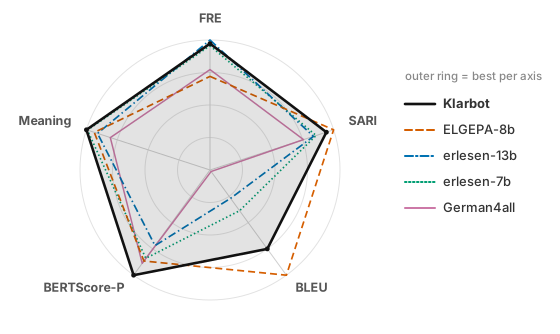
The same rules steer Klarbot’s Supervisor, the bounded loop I walk through in Agents That Know When to Stop, and the system runs on an open-weights base model with no task-specific fine-tuning. Over a shared pool of 997 documents we compared it against four German specialists that were fine-tuned for the task: on reference-free readability it is level with the strongest of them and ahead of the rest, it ties the best specialist on SARI where human references exist, and it has the lowest content-deletion rate under one meaning check, so it does not buy simplicity by dropping facts.
The human stays in the loop
KLAR reads simplicity, not meaning, and Klarbot does not replace the Prüfgruppe, the review by people from the target group that Leichte Sprache legally requires. It hands that panel a measurable first draft and a rule-by-rule account of where the text stands. Because the system carries no fine-tuning, a stronger German base model can drop into the same pipeline at no retraining cost.
The system and the rule engine are proprietary, but the formulas, the operational rule definitions, and the per-document scores in the paper are public: FraunhoferIAIS/KLAR on Hugging Face.