
Finishing Sentences to Know Yourself Better


DISCLAIMER: The views and opinions expressed in this blog are solely my own and do not reflect those of my employer, or any of its affiliates.
TL;DR; Most books about change start from knowing where you are, and that is harder than it sounds, because we are good at lying to ourselves. I found an exercise that makes it a little harder to look away, and I built a small offline app around it.
Most of the self-help books I have read recently1 agree on one thing: change starts with knowing where you are. Nathaniel Branden calls this living consciously, the first pillar in Six Pillars of Self-Esteem: “To live consciously means to seek to be aware of everything that bears on our actions, purposes, values, and goals … and to behave in accordance with that which we see and know”.
I was skeptical at first, since who doesn’t know their own self? But we are good at lying to ourselves to make reality match our worldview. Mine is a classic: I say “I’m fine” and hope someone notices I’m not.
AwareMe is a private, on-device Android app for the sentence-completion exercise Branden developed to increase self-awareness. It has no network connection, and it is open source, with the code on GitHub.
It is an independent project, not an official Branden product, and it is not a substitute for therapy.
The exercise
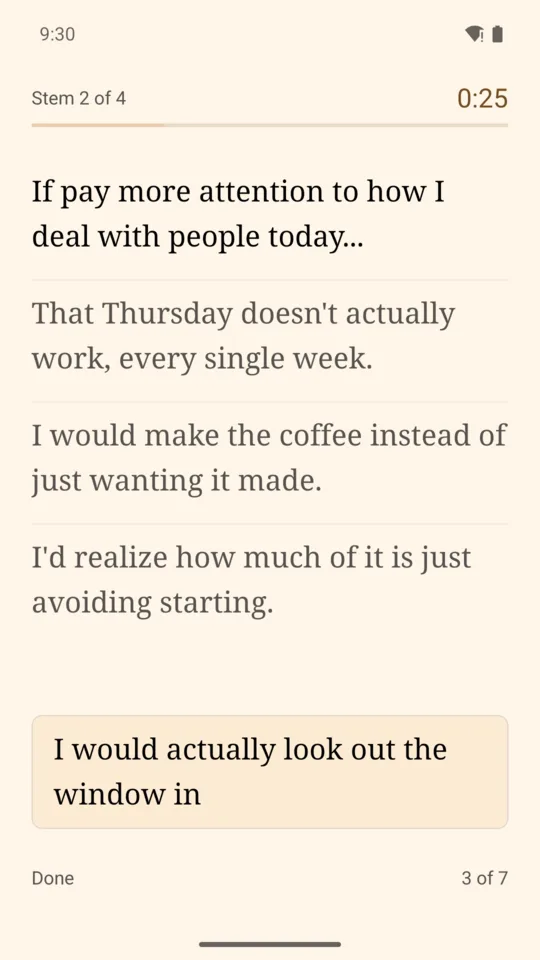
You start with a half sentence (a stem), like
If I ask directly for what I need instead of hinting…2
Then just jot down six to ten endings for this sentence. For example
- I would ask for more feedback at work
- I will ask to go back home earlier cos I’m tired
- I need more time to prepare for the workshop
- I need to take it slow
- I need some time to breathe
- I need to be included in the decision making process if a decision affects me too
Maybe you see yourself in some of these, maybe you don’t. But I want to put emphasis on what these endings express: things I would not have said if you asked me “what do you need?” point blank.
Take 2, for example. Why do I even hint instead of asking directly if I am tired? Is being tired not OK? Is it better to be half-zombie at an event just so I’m there? Or would it be better to enjoy the event for a shorter time, fully present?
Take 4 and 5 as well: rereading them, I can see that I’m stressed. And I probably need a todo and priority list, because the ones I have right now are overwhelming me (thanks wify for the tip on this one).
The others point to feelings I often choose to ignore instead of facing. Sharing this with random strangers online makes me feel vulnerable, but I think it is a good way to grow and connect with you.
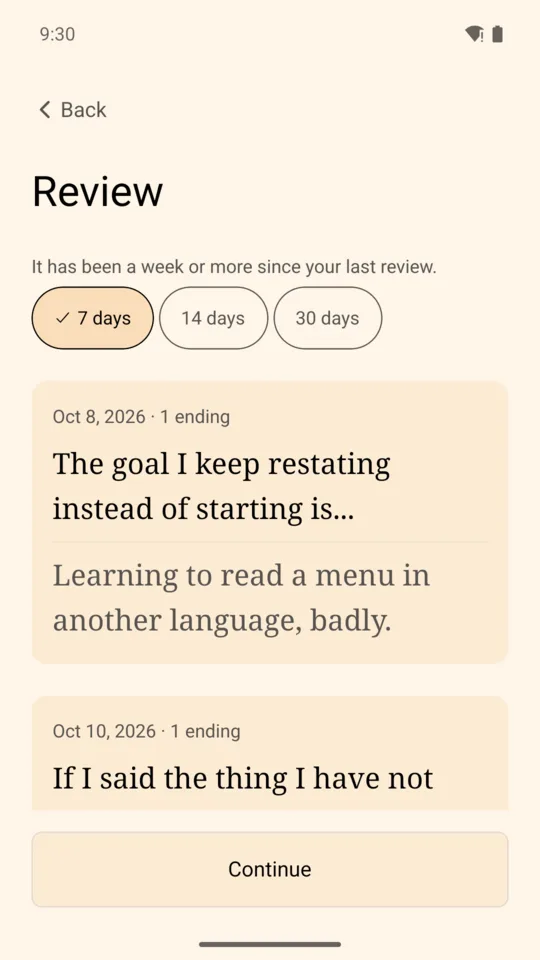
The technique has value, and it shows only after some repetition. Three weeks in, rereading is where it pays off.
What the app does
The official instructions and programme are published on Branden’s own site. The app lets you either follow the official programme3 or define your own stems.
- Morning practice. The core of the app: you work through your stems and write your endings.
- Evening practice. Optional: it shows that morning’s endings and closes with a reflection.
- Weekly reflection. It gathers the week’s writing for re-reading on a day you choose.
- No deleting. To keep you from thinking twice about a stem, the app forbids word deletion. Once you write a word, there is no going back. This helped me a lot during my practice: sometimes I go back on stems because I don’t find them useful, but then the app forces me to finish them, and it’s always worth it.
- A timer. For additional pressure (think Pomodoro, but for honesty). It’s important to jot down your thoughts, not compile a curated list, so the timer pushes you to finish.
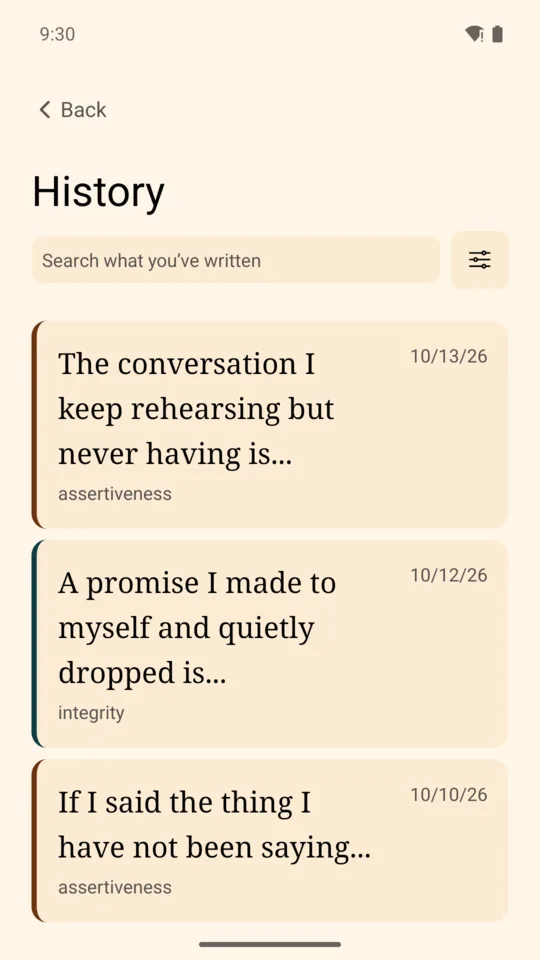
- History. Every session is kept, browsable, and full-text searchable, because the exercise accrues its value over weeks, through re-reading.
The app has no network connection, and you can export everything losslessly to SQLite, JSON, and CSV. To me this is important: I like analysing data, and I found some patterns by day of the week (on Mondays I have more stressed feelings; shocked Pikachu face).
Why I built it
Once I found out the technique works for me, my first reflex was to look for an app and, surprise, none of them satisfied me. At the same time I was testing a new agent harness called pi, and what better testing environment than app development? So here we are, with AwareMe.
Try it out! It’s free, and you can download the build from GitHub. I would love your feedback, and if you are interested in the actual development process, with pi and agents, reach out!
-
Set Boundaries, Find Peace, Daring Greatly, Six Pillars of Self-Esteem, and The Mountain Is You. ↩
-
One of my favourites, given the passive communication style I inherited from Italy. ↩
-
Thank you to Leigh Branden, who granted permission to bundle the official programme with the app. ↩
If you like my work, consider buying me a coffee to support future posts.
